Troubleshooting gets harder when symptoms span domains and dependencies. An authentication service starts timing out. Several devices generate alerts. A switch configuration changed hours earlier. Each signal may be accurate, but none tells the whole story. That’s the problem NetOps teams face every day. They don't lack data. They lack the time to connect it.
Actions, now available through Conditional Availability (CA) beginning September 30, brings AgenticOps to Cisco networks, giving NetOps teams one place to engage with and govern their agentic workforce. It connects network intelligence with Deep Reasoning and agentic workflows to prioritize what matters, determine root cause, and drive confident remediation. As part of the AgenticOps loop, Actions turns trusted intelligence into agent-driven action and helps validate that those actions delivered the intended outcome.
This is an important step in a much bigger shift at Cisco as we move from AI that helps operators interpret the network to AgenticOps, where humans and AI agents work together to investigate, reason, and ultimately act with greater speed and confidence.
Start with Correlated Incidents
Traditional network operations often begin with an alert. Then another. Then another. The operator becomes the correlation engine, working across devices and dashboards to determine whether ten alerts represent ten problems or ten symptoms of the same problem.
Actions changes that starting point. With the new Incidents experience, related issues can be correlated and presented as a single incident. Instead of asking an operator to assemble the story, agents begin assembling it for them, helping to determine what happened, what is affected, the likely root cause, and the recommended actions to investigate or remediate the issue.
At CA, incident use cases include wireless association, authentication, DHCP, and DNS failures. Actions also supports a broader set of alerts, using agents and Deep Reasoning to identify root cause across issues such as VLAN mismatches, degraded Ethernet uplinks, topology changes, configuration issues, and connectivity problems.
The goal isn’t to give NetOps another place to manage alerts. It’s to give them an agentic workforce that can investigate issues, reason through complexity, identify root cause, and help drive the right action, while keeping teams in control.
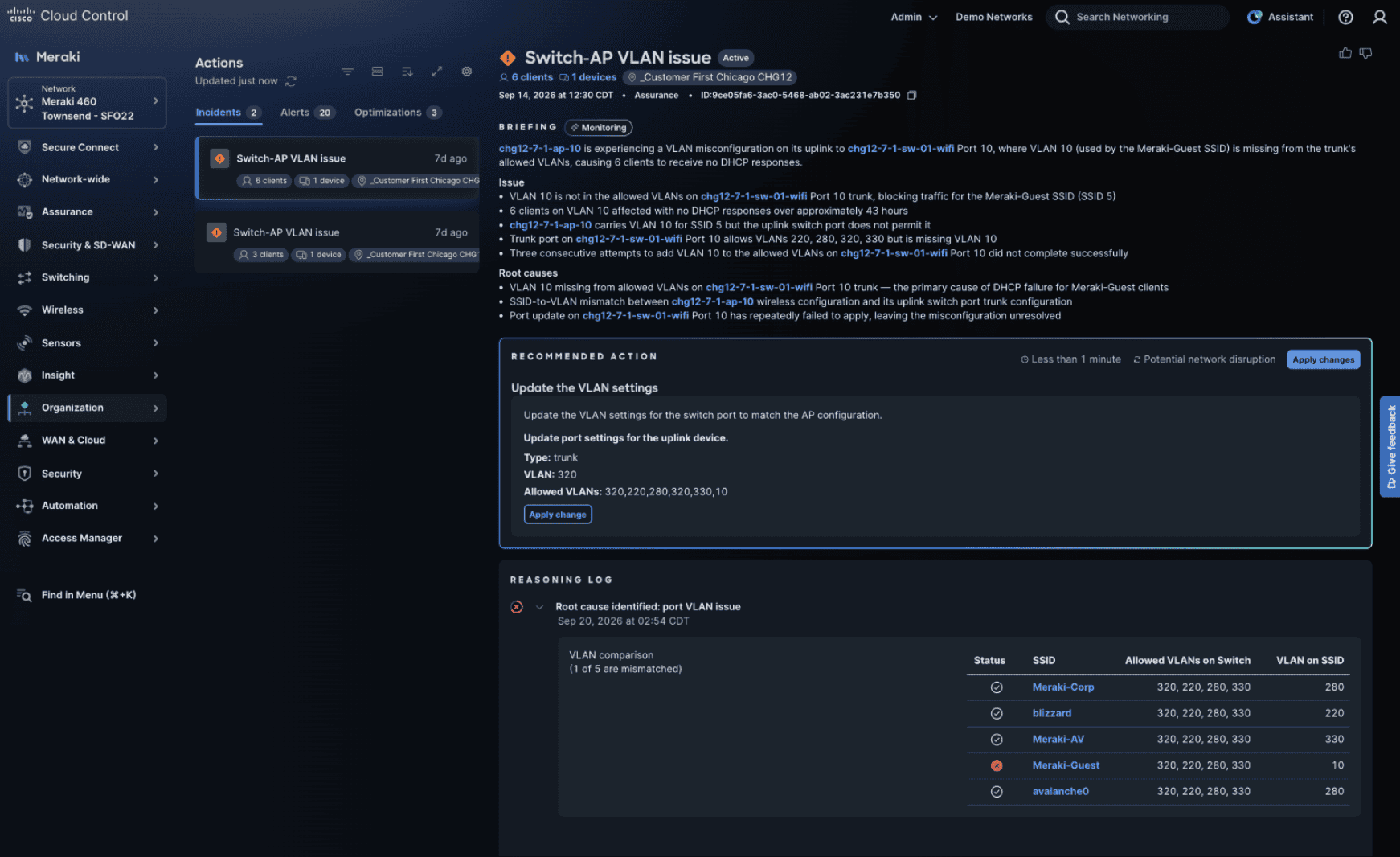
The Actions inbox brings incidents, alerts, and optimization opportunities into a common experience, with agents working behind the scenes to investigate, correlate, and prioritize what needs attention. Practitioners spend less time assembling context and more time acting on what matters. For IT leaders, it creates a path to reducing the operational burden of alert volume, tool switching, and repetitive triage.
Investigate Deeper with Deep Reasoning
Correlation can tell you that signals belong together. Agent-powered RCA can identify likely causes for known patterns. But networks don’t always follow the playbook.
Complex problems can involve topology, configuration, dependencies, recent changes, client behavior, and multiple plausible explanations. These are the situations where an experienced engineer keeps asking questions, testing each hypothesis against the evidence before reaching a conclusion.
Actions brings Deep Reasoning directly into the incident and alert experience, giving ambient agents the ability to investigate beyond known patterns when the answer isn’t immediately clear. These always-on, context-aware agents can invoke Deep Reasoning within the workflow, while operators can also use it on demand for alerts that require deeper investigation. For CA, Deep Reasoning is preloaded for supported incidents and available on demand for alerts that require deeper agent-driven investigation.
When symptoms are ambiguous, dependencies span domains, or an issue falls outside a standard playbook, Cisco agents can use Deep Reasoning to plan an investigation, gather evidence, test competing hypotheses, and refine their conclusions as new information emerges. Operators have access to those same capabilities, allowing them to investigate further, ask follow-up questions, or introduce additional context.
Deep Reasoning helps agents and operators work through the questions that matter:
“What happened?”
“What is the impact?”
“Why did it happen?”
“What evidence supports that conclusion?”
“What should happen next?”
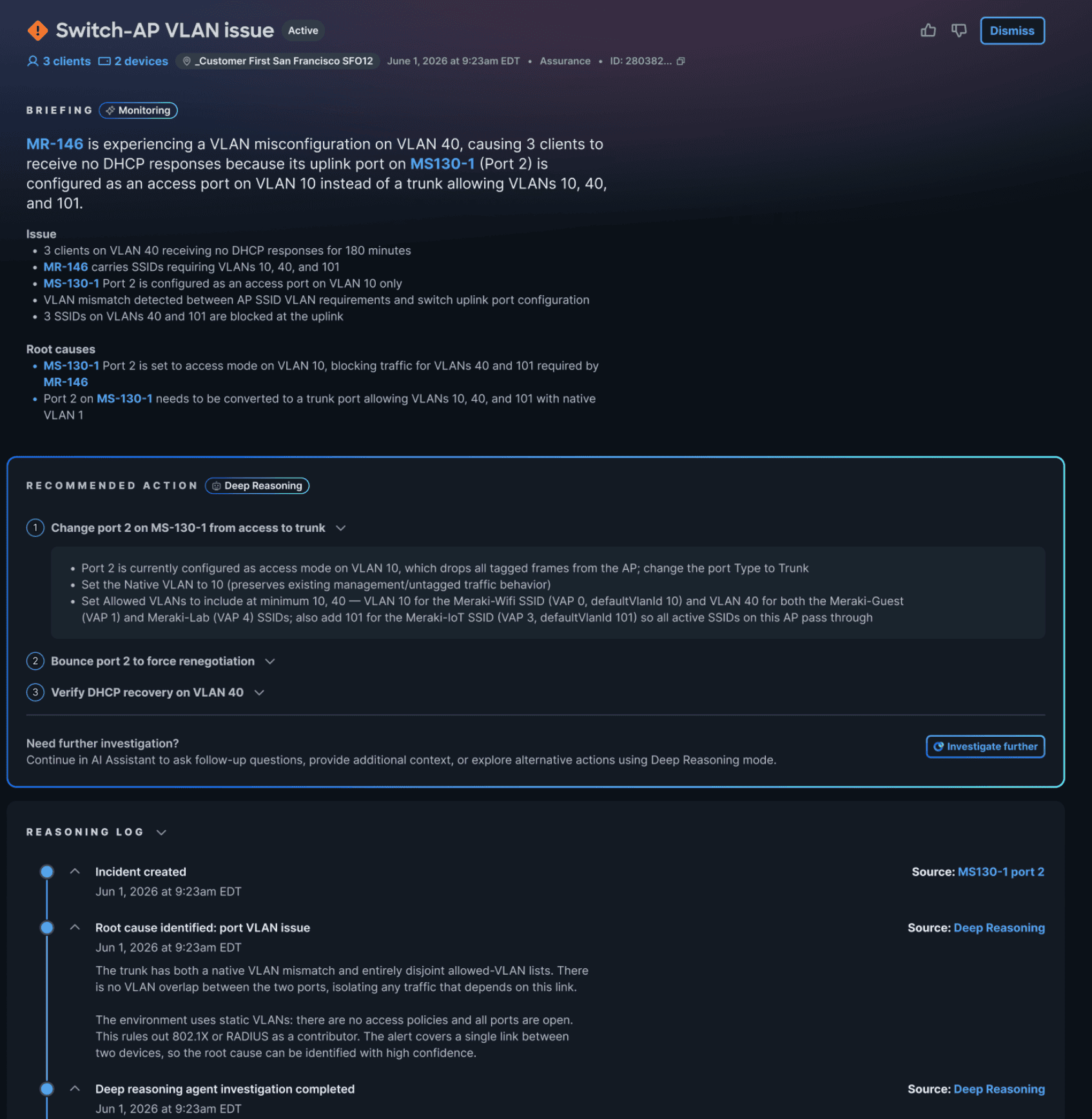
The result isn’t simply an answer, but an evidence-backed investigation that shows how that answer was reached. From there, Actions can help turn prioritized recommendations into governed remediation and validate the outcome. Whether the investigation is performed by an ambient agent or an operator using Cisco AI Assistant, Deep Reasoning helps teams move from signal to root cause, recommended action, and resolution with greater confidence.
From Insights to Actions
Finding the root cause is only useful if you can trust what comes next. For each incident, Actions provides an AI-generated briefing and prioritized recommended actions, while giving teams visibility into how the agent reached its conclusions. A dynamic reasoning log shows the evidence considered, the root cause identified, and the actions taken, giving NetOps a traceable record to understand, verify, and trust the path from investigation to remediation.
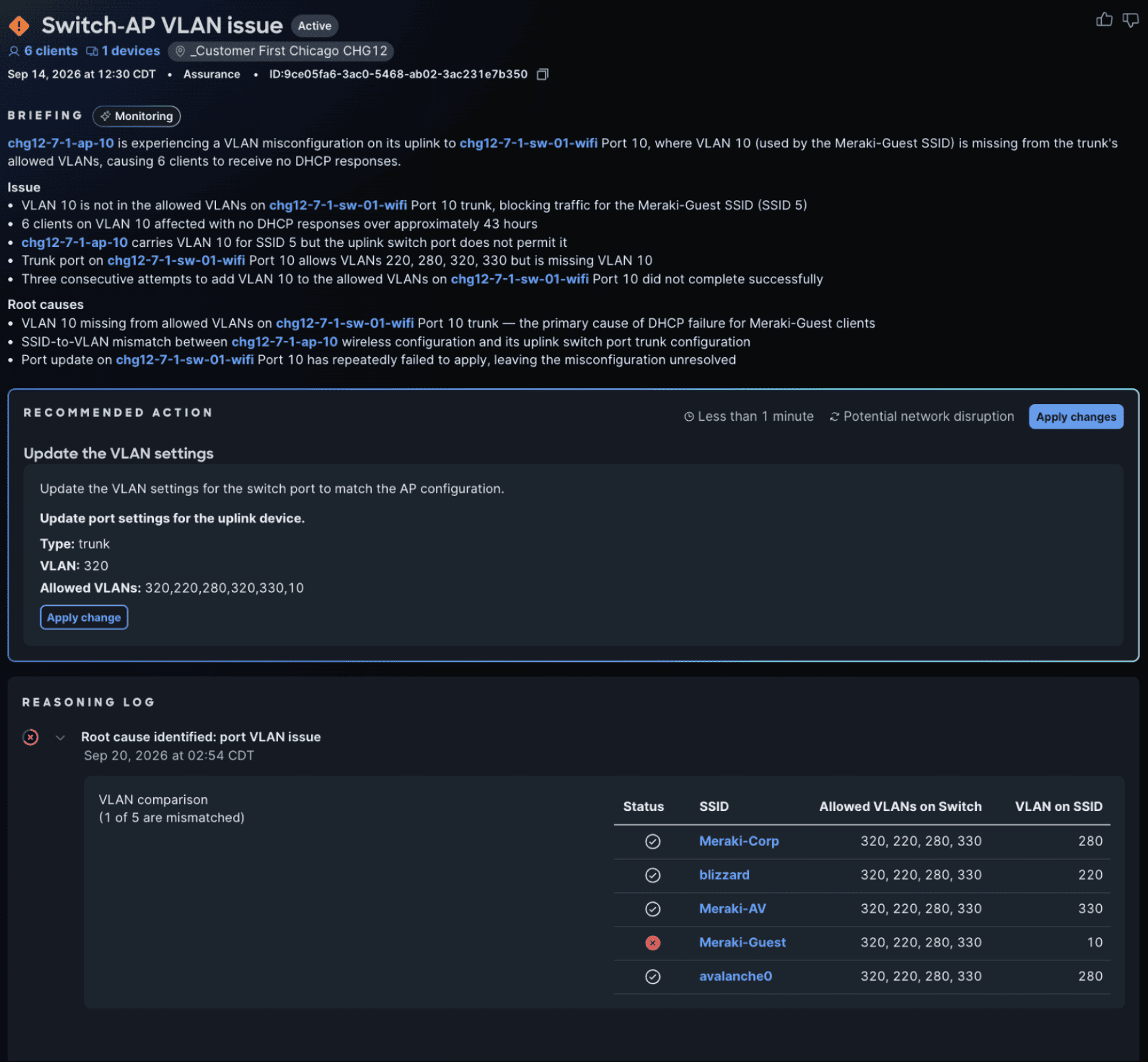
This is where the longer-term AgenticOps direction becomes important. Organizations need a path that goes beyond simply automating workflows to progressively expanding what agents can do on their behalf. As trust builds, agents can take on greater autonomy, reasoning through problems, deciding which tools to use, determining how to investigate, and choosing the appropriate next step. This progression allows teams to move from manual action to automated workflows and increasingly autonomous agents, while maintaining the oversight and control needed at every stage.
The September 30 CA release lays an important part of that foundation. It brings together correlated incidents, agent-driven investigation and Deep Reasoning, recommended actions, and visibility into the evidence behind each conclusion. By showing operators how agents investigate, reason, and arrive at a recommended course of action, the Actions interface helps teams build trust before granting agents greater autonomy. That progression matters: trust should precede autonomy, not follow it.
Experience Metrics and Actions to Drive the Agentic Loop
AgenticOps changes what teams can bring to the investigation. Cisco agents can draw on extensive assurance data, experience intelligence, and Deep Reasoning to investigate issues across domains and pinpoint problems with greater accuracy. That broader context matters because device health alone can’t tell you whether someone can join a meeting, authenticate to Wi-Fi, or reach a critical application. The network can appear healthy while the user experience tells a very different story.
Actions puts user experience directly into the agent’s line of sight. With Experience Metrics integrated into Actions, agents work from an understanding of the experience users are having, not just network telemetry. That context helps them prioritize what matters, investigate impact, and connect signals to root cause and action.
The use cases introduced in CA show how this experience-first approach works in practice. For supported wireless incidents, Actions uses degradation in the Wireless Successful Connections Experience Metric to identify when user experience is being affected. From there, agents investigate and correlate potential causes including association, authentication, DHCP, and DNS failures to help pinpoint what is driving the degradation.
Together, these capabilities form the foundation for AgenticOps.
Sense: Experience Metrics gives agents an understanding of what users are experiencing.
Reason: Actions brings that experience context together with assurance intelligence, agent-driven root cause analysis, and Deep Reasoning to investigate why.
Act: Recommended actions help determine the appropriate next step, with teams maintaining oversight and control.
Validate: As autonomy advances, outcome validation provides evidence that the action delivered the intended result.
This is how Actions helps teams progress toward greater agent autonomy: sense what is happening, reason through why, act with confidence, and validate the outcome.
The Human Control Layer for AgenticOps
There is another reason this evolution matters. As the volume and complexity of operational work grows, AI assistance alone simply won’t be enough. NetOps teams need agents that can go further investigating issues, reasoning through complexity, determining what requires attention, and helping drive the appropriate action. At the same time, teams need visibility into what agents are doing, the evidence behind their conclusions, and the ability to maintain oversight as agent autonomy grows. That’s the role we see Actions playing within Cisco AgenticOps, one place to engage with and govern your agentic workforce.
The September 30 release builds on Cisco AgenticOps by giving NetOps teams a single interface to engage with Cisco agents and the work they perform. Within Actions, teams can move from incidents and alerts into agent-led investigation, Deep Reasoning, and recommended actions without stitching together separate workflows. It creates a common place for NetOps to work with its growing agentic workforce as agents take on a larger role in day-to-day operations.
Agent-driven Action
NetOps isn’t suffering from a lack of data. It’s drowning in it. Telemetry, alerts, dashboards, and recommendations continue to multiply. AgenticOps changes the equation by putting agents to work making sense of that complexity, determining what matters, and helping turn insight into action.
The objective isn’t simply to tell an operator that something is wrong. It’s to understand the experience, connect the signals, investigate the cause, reason through complexity, and help determine the right next action. Moving from assistance toward greater agent autonomy is a journey built on trust one Cisco doesn’t take lightly. That trust must be earned through transparency, evidence, validation, and human oversight at every step. With correlated incidents, expanded agent-powered RCA, and Deep Reasoning coming together in Actions, we’re taking another significant step in that direction.
To learn more about Actions, view our interactive learning module or review Actions documentation.